

Where compute gets serious.
Forge is ArctiCore’s accelerated platform — engineered around GPU workloads, sustained thermal load, and the throughput that serious compute demands.
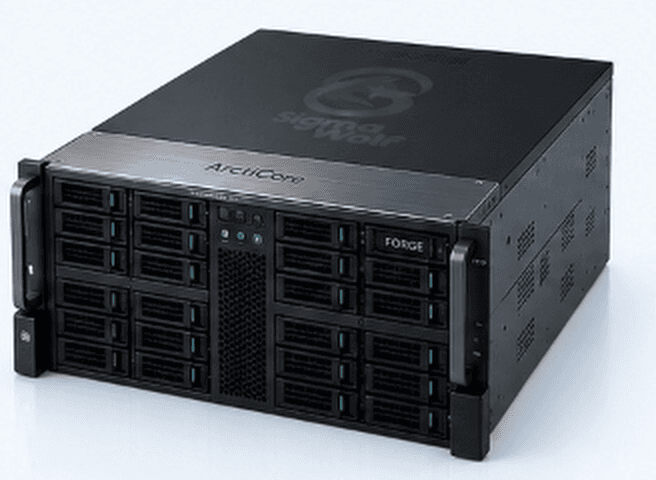
Accelerated workloads need infrastructure engineered around the accelerator.
GPU-heavy workloads don’t fail gracefully on general-purpose infrastructure — they bottleneck on power, thermals, and networking long before the compute itself runs out of headroom.
Forge exists because accelerated computing needs infrastructure designed around the accelerator from the start, not general-purpose infrastructure with a GPU added afterward.
Where Forge tends to run.
These are common environments, not a fixed list of what Forge can do.
AI workloads
Training and inference pipelines that live and die by sustained throughput.
GPU computing
Workloads built around parallel processing rather than single-core performance.
Model development
Iterative work that needs consistent, predictable acceleration.
Accelerated analytics
Large-scale data processing where GPU acceleration changes what’s practical.
Rendering / simulation
Workloads with sustained, heavy GPU utilization over long job runs.
High-performance compute
Work that outgrows what standard infrastructure can sustain.
Dense. Accelerated. Parallel. Thermally aware.
Forge’s architecture starts from the accelerator outward — power delivery, cooling, and networking are engineered around sustained GPU load, not retrofitted around it.
- Dense
- Accelerated
- Parallel
- Thermally aware
Dual Xeon/EPYC Host Sockets feeding direct PCIe Gen 5 root complexes
4x 400GbE / InfiniBand NDR channels bypassing CPU memory bottlenecks
Every component brings a capability.
These aren’t line items on a shopping list. They’re the building blocks the engineering team draws on to assemble the system your workload actually needs.
Compute
Processing power engineered to keep pace with sustained acceleration.
GPU
Acceleration at the center of the platform, not an addition to it.
Memory
Bandwidth sized for the data volumes accelerated workloads move.
Storage
Throughput engineered to keep the accelerator fed, not waiting.
Networking
Connectivity engineered for the data movement accelerated pipelines demand.
Power
Delivery and redundancy sized for sustained, not peak, GPU load.
Cooling
Thermal design built around continuous high-density heat, not occasional spikes.
The same discipline, engineered for acceleration.
For Forge, engineering means designing power and cooling around sustained GPU load from the start — not adding capacity after the fact.
Understand
Understand the model, pipeline, or workload driving the acceleration need.
Architect
Determine the right GPU topology and system architecture.
Engineer
Build power, cooling, and networking around sustained load.
Validate
Check thermal behavior, throughput, and operational fit under real load.
Deploy
Bring the system into your environment, ready for sustained use.
Support
Stand behind infrastructure carrying continuous, demanding load.
Evolve
Adapt as models, pipelines, and acceleration needs change.
You envision. The components contribute. The Wolves engineer. ArctiCore brings it to life.
Who Forge tends to fit.
General patterns, not a customer list.
Teams training or fine-tuning models
Needing sustained, predictable acceleration rather than occasional GPU access.
Studios running rendering or simulation
With workloads that keep GPUs under heavy load for extended job runs.
Organizations scaling accelerated analytics
Where GPU throughput has become the constraint on what’s practical.
Forge is part of the ArctiCore family.
Platforms are engineered independently, but they’re not engineered in isolation.
Forge often pairs with Nexus when accelerated workloads need to integrate into a broader environment.
Forge is frequently one part of a larger accelerated-compute environment.
Not sure if this is the right starting point?
Perfect. That’s what the Wolves are for.
Tell us what you’re trying to accomplish.
Let’s figure it out together.