

Built around the data that matters.
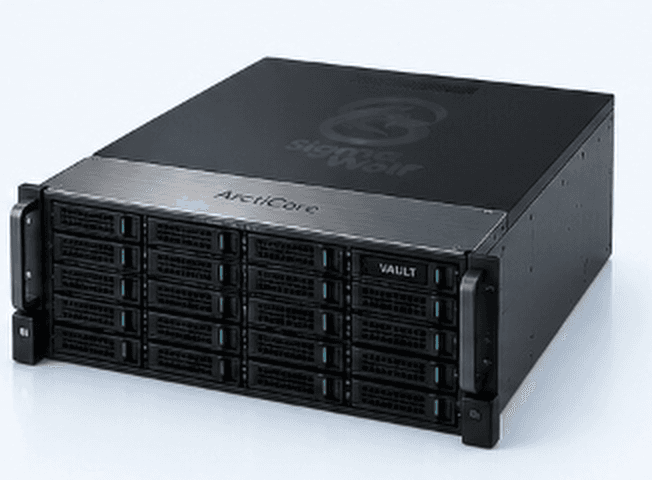
Vault is ArctiCore’s data and storage infrastructure platform — engineered around the way your data needs to perform, remain available, stay protected, and grow.
Data becomes infrastructure the moment the business depends on it.
Applications can be rebuilt. Workloads can move. But the data underneath them often carries the history, decisions, operations, and continuity of the business.
Vault exists to give that data infrastructure designed around its role — balancing capacity, performance, availability, protection, and growth rather than treating storage as an afterthought.
Where Vault tends to run.
These are common environments, not a fixed list of what Vault can do.
Data-intensive applications
Infrastructure built around workloads where data volume and sustained access matter.
Enterprise databases
Storage environments where availability, throughput, and operational consistency matter.
Backup and recovery
Infrastructure designed to keep recoverable data available when it is needed.
File and data repositories
Centralized infrastructure for data that teams and applications depend on.
Media and large datasets
Capacity and throughput for environments working with substantial volumes of data.
Long-term data infrastructure
Storage designed with growth, retention, and changing requirements in mind.
Available. Protected. Performant. Ready to grow.
Vault starts with the data — how much exists, how quickly it needs to move, how available it needs to remain, and how the environment needs to evolve over time.
- Available
- Protected
- Performant
- Scalable
PCIe Gen 5 NVMe write-caching & lightning metadata indexing
Dual-parity RAID-Z2/Z3, silent data corruption self-healing & snapshotting
Up to 24–60 high-capacity drives per 4U enclosure with JBOD daisy-chaining
Every layer protects the value of the data.
These aren’t line items on a shopping list. They’re the building blocks the engineering team considers when designing infrastructure around the data your business depends on.
Capacity
Storage designed around current requirements with room for the environment to evolve.
Performance
Throughput and access characteristics aligned with the demands of the workload.
Availability
Infrastructure designed to keep important data accessible when the business needs it.
Protection
Architecture that considers how data is safeguarded against loss, failure, and operational mistakes.
Connectivity
Data infrastructure positioned where applications, compute, and users need to reach it.
Expansion
A foundation designed to accommodate changing capacity and workload requirements.
Engineer the storage around the data, not the other way around.
For Vault, engineering starts by understanding the data — its value, behavior, access patterns, protection requirements, and expected growth.
Understand
Understand the data, workload, access patterns, and operational requirements.
Classify
Identify what needs performance, availability, protection, capacity, or a combination of them.
Architect
Design the storage environment around those priorities.
Protect
Build appropriate resilience and data-protection considerations into the architecture.
Validate
Check performance, availability, recoverability, and operational fit.
Deploy
Introduce the environment with minimal disruption to the systems and data already in use.
Evolve
Expand and adapt the infrastructure as the data environment grows.
You envision. The components contribute. The Wolves engineer. ArctiCore brings it to life.
Who Vault tends to fit.
General patterns, not a customer list.
Teams managing growing data environments
That need storage infrastructure designed for today’s requirements and tomorrow’s growth.
Organizations protecting business-critical data
That need availability and recoverability to be part of the infrastructure conversation.
Teams running data-intensive workloads
Where storage performance and capacity directly influence the workload experience.
Vault is part of the ArctiCore family.
Platforms are engineered independently, but they’re not engineered in isolation.
Vault can provide the dedicated data infrastructure behind a coordinated Nexus environment.
Vault may support substantial general-purpose compute where workloads depend on dedicated data infrastructure.
Vault can provide the data layer around accelerated workloads that process substantial datasets.
Vault may support distributed environments where data needs to remain available beyond the primary infrastructure footprint.
Not sure if Vault is the right starting point?
Perfect. That’s what the Wolves are for.
Tell us what your data needs to do.
Let’s figure it out together.